Economy model A
Handles bounded, local work
Answer→Tools→Continue
A’s prefix keeps growingTool round-trips keep the model stable


A long task need not rely on one model from start to finish. Match the agent to the task, then choose the right model for each stage—guided by past performance and the work ahead.
JevOfficial extension · One call to choose and assessCode, research, analysis, and automation. Keep your workflow and spend compute where it counts.
One task. The right model at each stage.Understand → Use tools → Verify
Reuse the prefix throughout the stageReason → Implement → Check the result
Build a new prefix, then keep reusing itIllustration · Reassessment can also keep the same model
A new user prompt is not the only boundary. When a long session compacts and rebuilds its context, HiRoute gets another natural chance to choose; ordinary tool continuations stay on the current model.
Handles bounded, local work
Example: the next stage needs deeper reasoning
Example: performance is competent
Compaction rebuilds a long session around a new prefix. HiRoute uses that moment to assess the prior stage and the work ahead; the client does not need to detect or report compaction separately.
Assess the prior stageAssess the work already performed by model A
Choose the next branchChoose the primary branch; model B takes over
Combine the current task with execution history. One upstream request chooses the next branch and can assess the previous model’s competence.
Deploy the Jev extension ↗Swipe to explore the full diagram
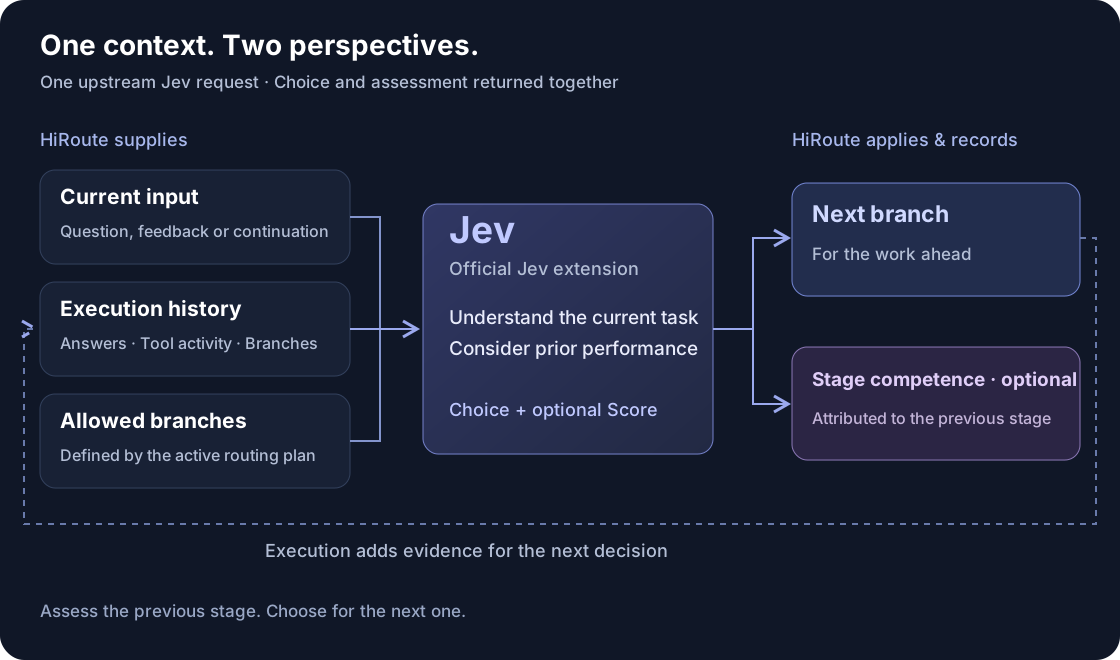
Jev estimates the probability that the task is simple. Only consider economy when it meets your threshold; complex work stays on primary.
A low assessment of the previous stage blocks cost-cutting. A high score cannot override task complexity; without a valid score, complexity alone decides.
Competence blocks risky cost-cutting; complexity creates opportunities to save.
Rules policy in the official extension · Configurable thresholds · Jev is optionalReview stage competence over time for models selected by the current plan—without typing internal model IDs.
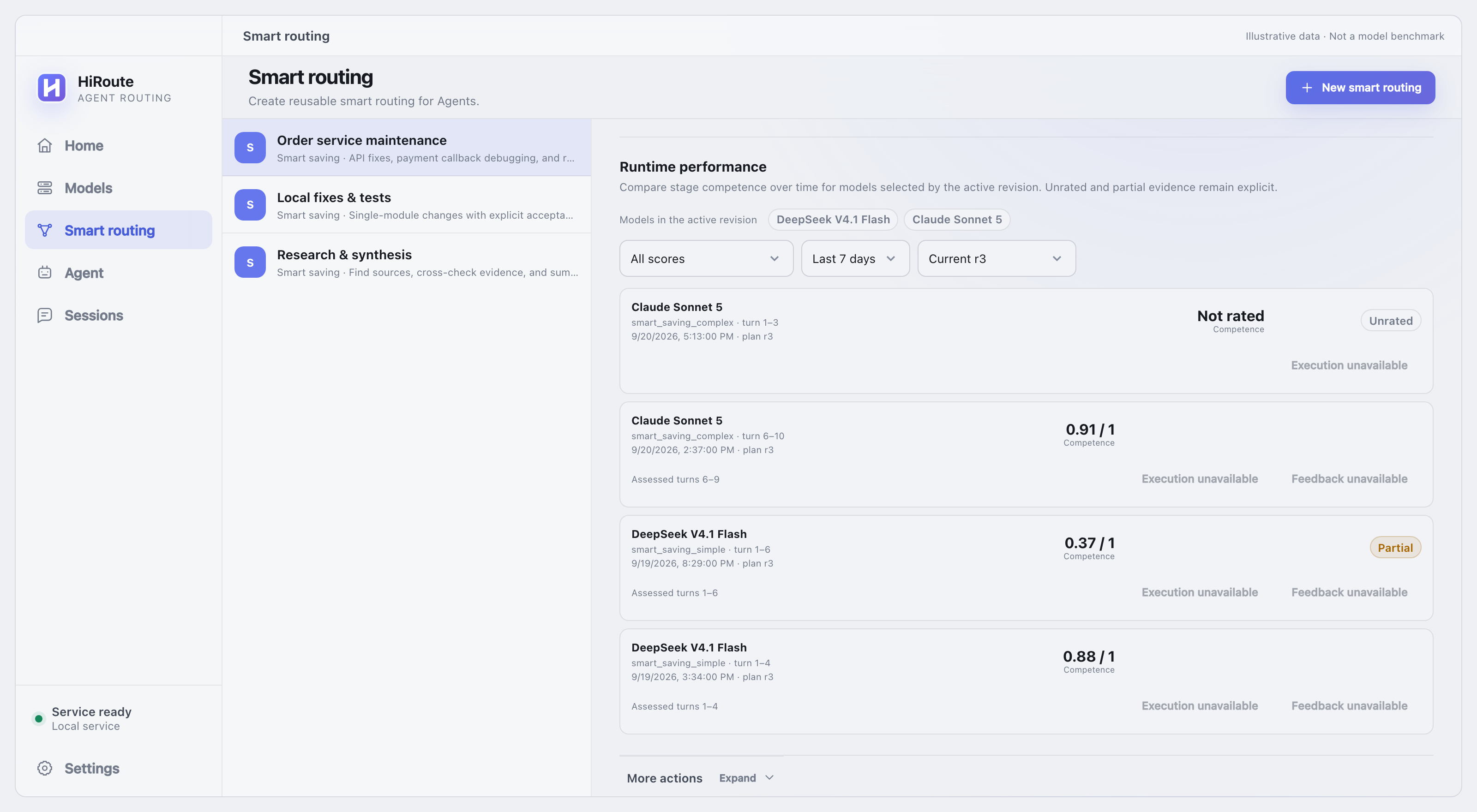
Real product components · Illustrative data, not a model benchmark. Unrated, partial, and not-yet-covered turns remain explicit.
A score belongs to a plan, revision, model, and execution stage; new turns are not silently covered by an older assessment.
A main agent can query high- and low-scoring tasks, inspect evidence, and propose a narrower work plan.
Designed for coding, research, deep analysis, and general automation—not around one hard-coded agent.
A main agent discovers allowed work plans, delegates a goal, and retrieves the result. Delegation and model routing remain independent.
Compose model sources, reasoning profiles, and ordered candidates; use smart saving, fixed, or free-first routing.
Candidates satisfy tool, image, and context requirements; exhaustion stops explicitly and delivery is not silently switched.
Integration status follows real support; available and planned paths stay visibly separate.
Order depends on real integration and validation.
Build a decision service with Jev, an LLM, or your own policy. The general API supports allowed-branch choice and optional competence scoring.
Decision API documentation →POST /v1/decisions
{
"branch_id": "smart_saving_simple",
"assessment": { "score": 0.82, "partial": false }
}Stable 0.1.0 is available for macOS Desktop / Linux headless.
x86_64 · 59.9 MB
curl -fsSL https://hiroute.ai/install.sh | shInstallation and startup →SHA256 b54b62e48d95…Different models do not share KV cache. HiRoute aligns model changes with natural rebuilds after context compaction when possible, while ordinary tool continuations stay on the same model. Actual hits still depend on provider, configuration, and cache lifetime.
It receives HiRoute’s independent simplified Agent-turn history: user input, accepted output, tool names and coarse outcomes, and executed branches. It is not a full transcript and can be marked partial after eviction or restart.
No. Built-in rules are enough to start; Jev is an optional official extension, and you can implement your own service against the same Decision API.
No. It represents competence for a specific execution stage and must be interpreted with plan, revision, assessment coverage, and partial-evidence state.