

Quickstart
Choose macOS Desktop or Linux headless, connect one model through a fixed route, then enable smart saving or task delegation when you need it. Getting started does not require an external decision service.
1. Choose how to run HiRoute
- macOS Desktop: requires macOS 15.0 or later. Public installers are self-signed builds. Verify the SHA256 after downloading, then follow Install and open HiRoute on macOS.
- Linux headless: designed for servers, remote workstations, and automation. It installs for the current user and needs no
sudo. Follow Run HiRoute headless on Linux to start the service and continue through the CLI.
Steps 2–5 below show the visual Desktop path. Linux users complete the corresponding flow through the same production capabilities in the headless guide. In either case, confirm that the local service is ready first; model routing, session records, and delegated execution all depend on it.
2. Connect a model
Open Models and select Add model. You can connect a supported local subscription, or open Advanced connection and choose Custom API.
Check the connection, select the model you want HiRoute to use, and save it. “Ready to route” means that the connection has the facts required by routing; it does not claim that every upstream model has completed a live inference test.
3. Create your first smart route
Open Smart routing and select New smart routing:
- Enter a name and purpose, such as “Daily development” and “Routine code changes.”
- For the first route, choose Fixed model and add the model you just connected.
- Select Enable. Only published and enabled routes handle new requests.
Once this path works, explore Smart saving and Free first in Use smart model routing.
4. Connect your agent
Open Agents, select a detected Codex or Claude Code installation, then:
- Open Model routing and select Enable.
- Turn on Use HiRoute model routing.
- Select your new smart route and make it the default choice.
- Save the configuration and complete any checks shown by the page.
HiRoute keeps a restore point. If you disable model routing later, use Connection details and recovery to restore the settings that existed before HiRoute managed the connection.
5. Send a real request
Return to your usual agent and submit a small task with a clear result. After it starts, open Sessions in HiRoute to inspect the route, actual model, usage, and execution state.
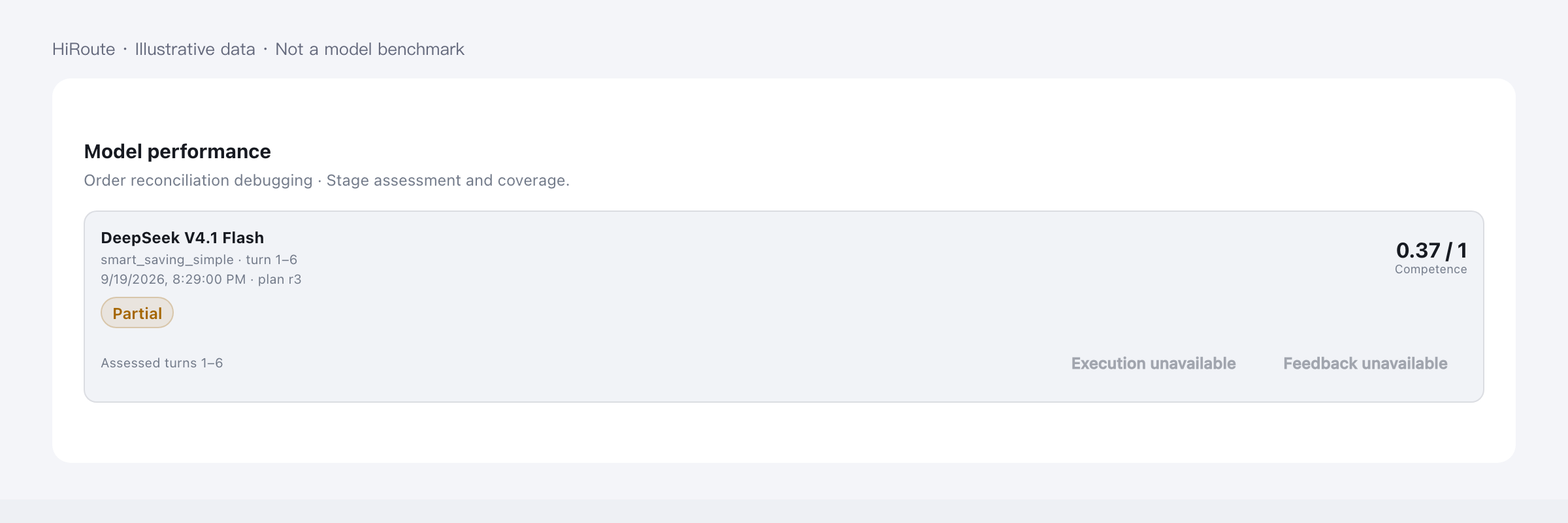
The screenshot uses illustrative data and is not a model benchmark.
Next steps
- Use smart model routing for routing modes, decision boundaries, and runtime performance.
- Use smart task routing to delegate independently executable work.
- Run HiRoute headless on Linux to install from an empty environment and configure models, routes, and Agents from the CLI.
- HiRoute CLI to manage HiRoute, inspect runtime facts, start tasks, and recover uncertain submissions from Terminal.