

HiRoute Smart Routing in Action: GPT-6 Astra × Qwen-3.8 Flash, Same Quality at 90% Lower Cost
How much can you save by reserving your strongest model for the decisions that need it?
We connected GPT-6 Astra and Qwen-3.8 Flash through one HiRoute routing plan, then put them to work on an engineering assignment spanning technical research and architecture review. In two runs meeting the same whole-delivery acceptance standard, the mixed setup cost 92.01% and 91.39% less than all-Astra execution.
A separate coding task, lasting about 32 minutes, demonstrated the other side of smart routing. When the economy model kept researching without moving into implementation, HiRoute automatically upgraded the model at a context handoff. Development continued, and the result passed 343 independent checks. Nobody added a prompt or manually switched models during the task.
Both cases illustrate the same idea: a long-running task benefits from the right capability at each stage.
HiRoute: the right model for each stage of a long task
HiRoute is an open-source routing engine that runs locally between your existing agent and model services, designed for long-running tasks. You keep asking coding agents such as Codex, Claude Code, Qoder, DeepSeek Harness, and Pi to do the work. The agent still reads files, writes code, and runs tests. HiRoute decides which model handles each stretch of work.
HiRoute also provides smart task routing. The main agent can choose a suitable execution agent through a published routing plan, delegate independent research, implementation, or testing work, and use the returned result to continue the overall task. Task routing assigns the executor; model routing chooses the model for each stage. They work independently or together, connecting agent collaboration with model selection. The two case studies below focus on model routing.
Connect your models in Desktop, create a routing plan, and point the agent at it. The agent uses one stable model alias while the models behind that alias can change with the task. The Sessions page shows which model actually ran, token usage, and assessments of earlier stages.
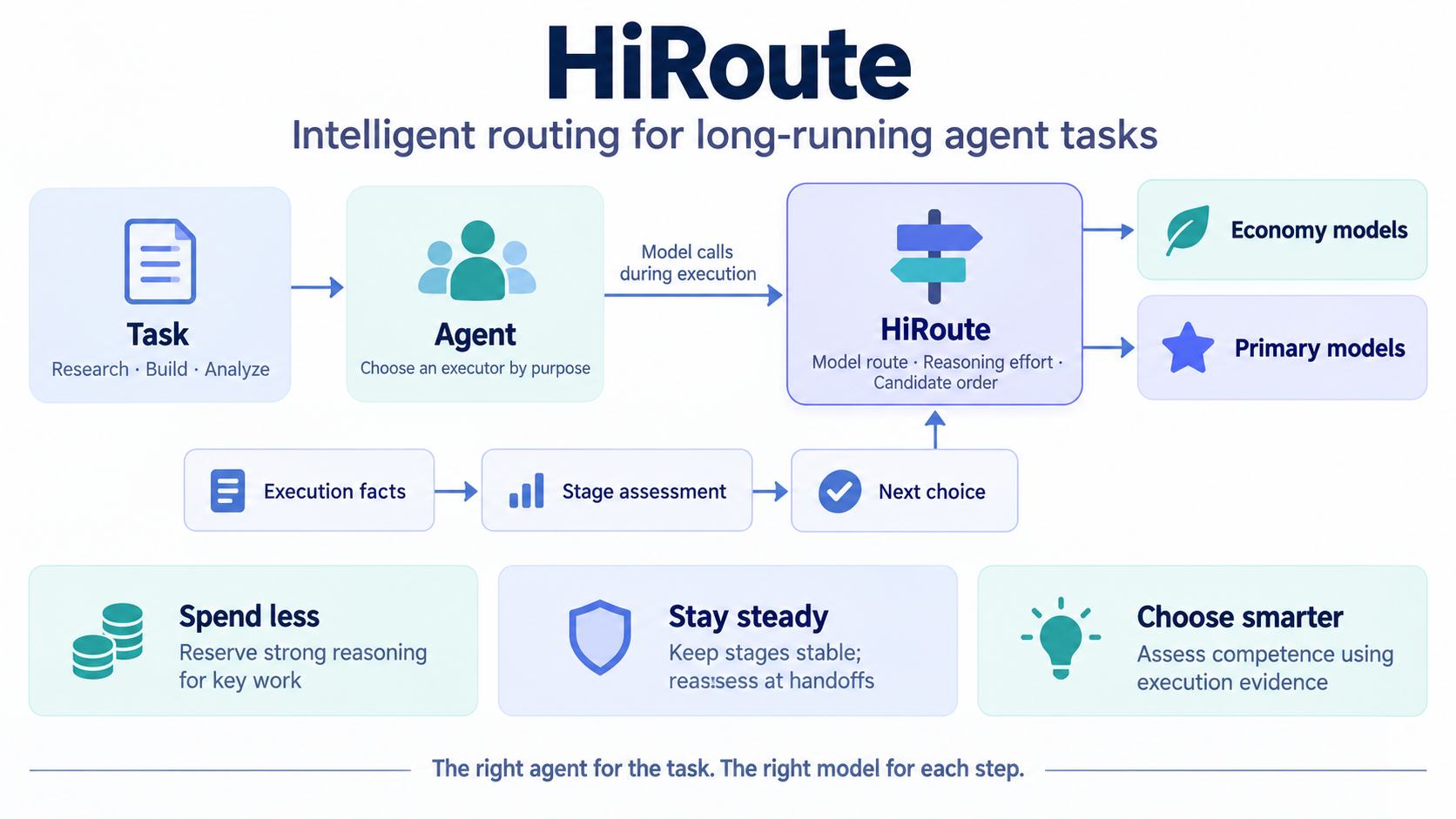
This fits the rhythm of software development: research, design, implementation, testing, and deeper investigation when something breaks. Organizing documented facts and deriving a new system guarantee demand different capabilities. Once the hard problem is solved, every remaining step may not need the most expensive model.
Case Study 1: reserve Astra for critical decisions and cut whole-task cost by 90%
We used a messaging-system design review to represent a familiar engineering workflow: research six candidate technologies, verify the official documentation, organize the comparison, and deliver a memo on a critical design decision.
The final decision asks a practical question: if the system fails midway and retries, how do you avoid processing the same business event twice—or missing it entirely? Finding “supports transactions” in the documentation is not enough. The model must determine whether the pieces together meet the business requirement.
The structure is widely familiar: a substantial amount of research supports a small number of critical judgments. Technology selection starts with feature comparisons and ends with a choice under real constraints. Migrations start with an inventory of differences and lead to decisions about risk and rollback. Compatibility reviews move from checking interfaces to identifying conflicts that affect the business. Every step needs care, but not every step needs the most expensive model.
We gave three modes the same task, source material, and delivery requirements:
| Mode | Actual division of work |
|---|---|
| All Astra | Astra handles research and the decision memo |
| HiRoute mixed | Qwen handles six research deliverables; Astra handles the critical decision memo |
| All Qwen | Qwen handles research and the decision memo |
HiRoute allocates capability by the work involved: Qwen organizes and verifies the research; Astra handles the critical reasoning. The stronger model takes on the portion that needs it.
Lower cost, with the critical judgment intact
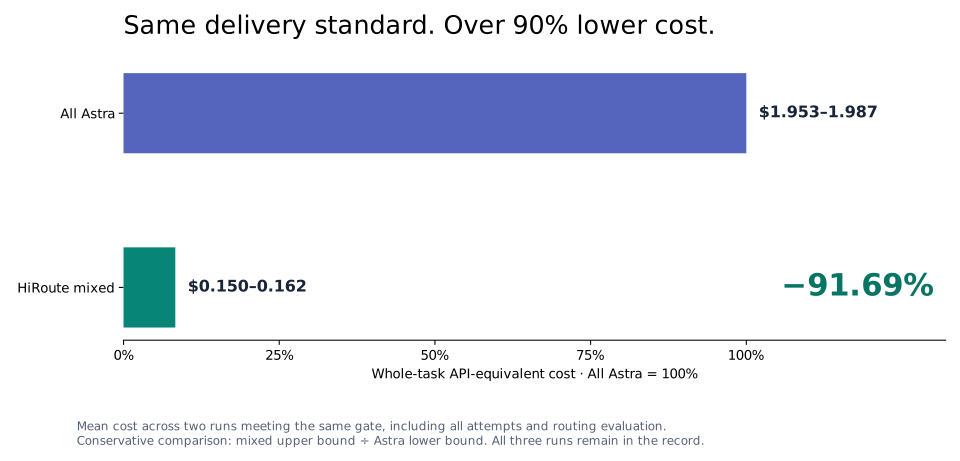
Across the two runs in which both modes passed the original whole-delivery gate, average research-check accuracy was 99.03% for HiRoute mixed and 99.72% for all Astra. Both passed the critical decision review. Whole-task cost fell by 91.39%–92.01%.
The three critical decision reviews show the capability gap more clearly:
| Mode | Critical decisions without major errors |
|---|---|
| HiRoute mixed | 3/3 |
| All Astra | 3/3 |
| All Qwen | 1/3 |
Qwen's research work was quite accurate. The gap appeared in the final judgment: two recommendations treated a guarantee within one component as a guarantee for the whole design. Those recommendations sound complete, but they can lead to the wrong architecture decision.
The mixed setup spent Astra's reasoning capability on that decision without making Astra handle all the research. Savings came from allocating the work; quality came from matching the critical judgment to sufficient capability. That is the useful pattern to carry into everyday engineering tasks.
The cost comparison uses the two of three primary runs where both modes met the original delivery standard, and includes all subject attempts and routing evaluation at API-equivalent prices. The experiment record retains every outcome and the acceptance criteria. “Same quality” means meeting the same delivery standard.
Configure the mixed-model plan
Desktop brings the setup into three steps: connect model services, configure the combination, and connect the agent. The agent can then use Qwen and Astra through one plan.
1. Connect your model services
Use the Models page to connect your own services and make Qwen and Astra available for routing. Manage each connection once and reuse it across plans.
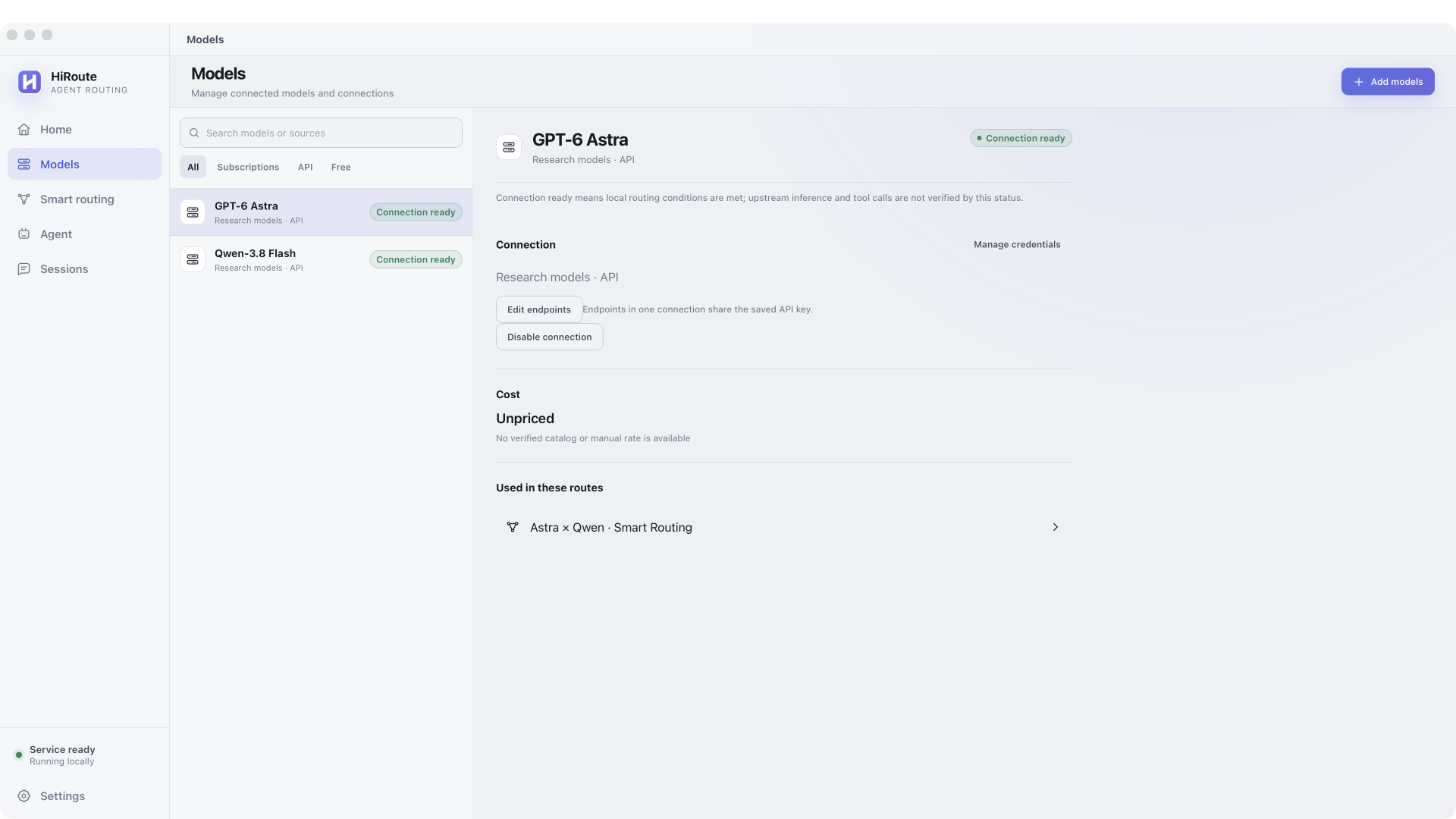
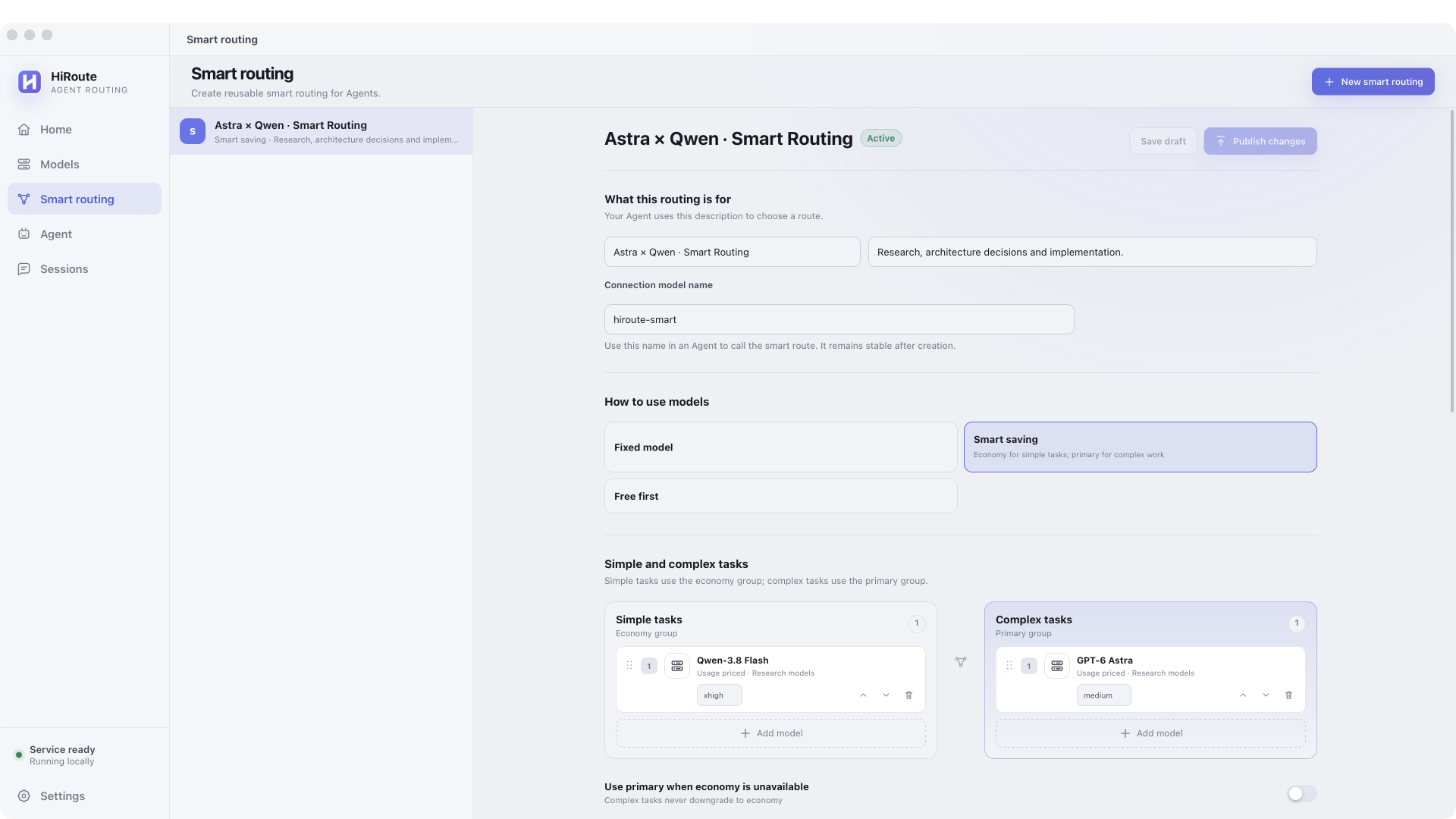
2. Create a Smart Saving plan
Open Smart Routing, choose Smart Saving, and place Qwen in the Economy group and Astra in the Primary group. This case used xhigh and medium reasoning settings respectively. Enable the plan, and the agent can access the combination through one model alias.
3. Use the plan in your existing workflow
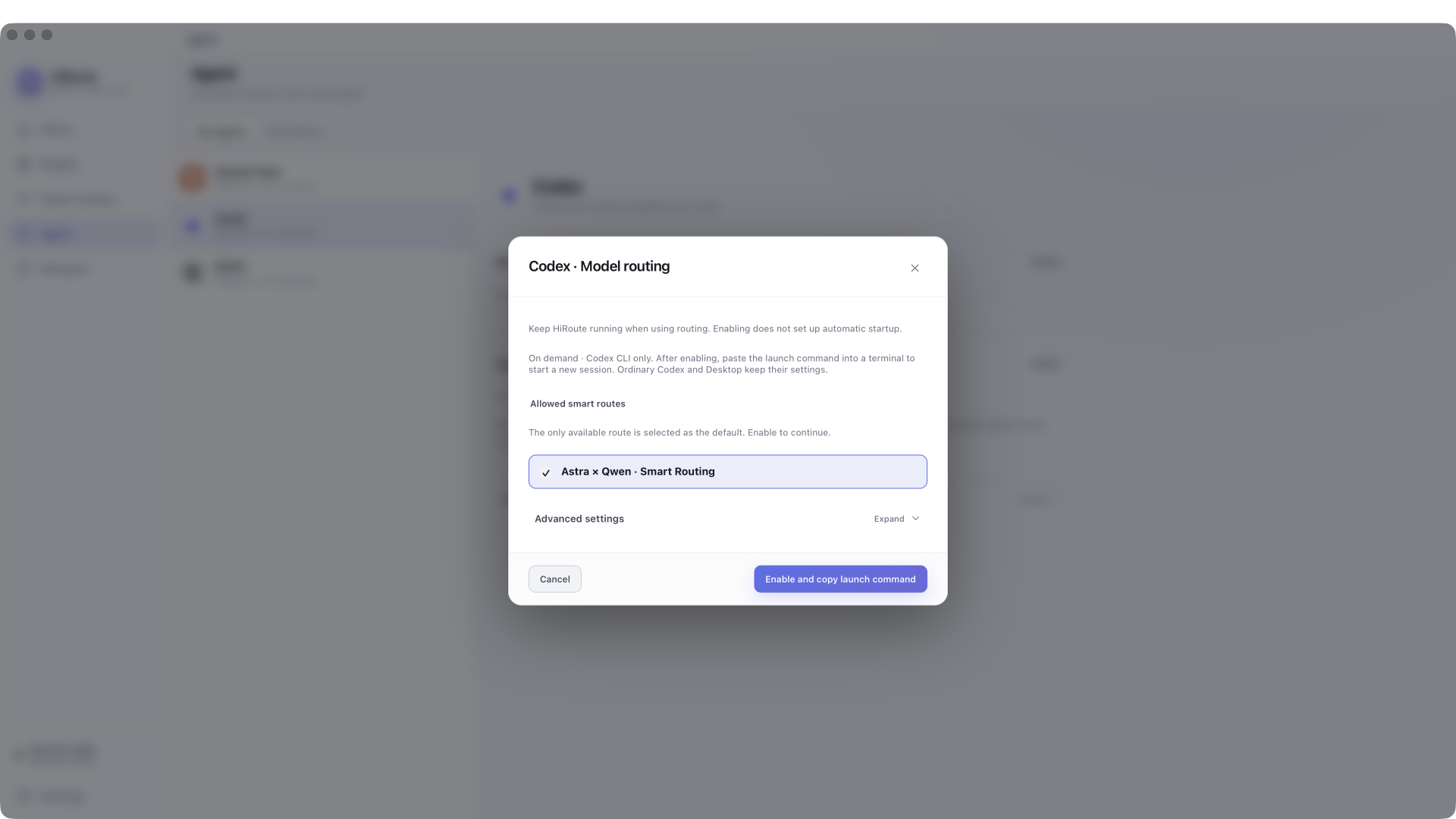
For Codex, open Model routing on the Agent page, select the plan, then enable it and copy the launch command to start a new session through HiRoute. Issue tasks as usual. The Sessions page lets you inspect the actual models and usage request by request.
Case Study 2: three automatic handoffs complete a task without intervention
The second case focused on sustained delivery: adding synchronous and asynchronous JSON stream iteration to HTTPX. The feature needed to support several JSON stream formats, handle encoding and consumption state, and yield parsed values before the rest of the data arrived. We gave native Codex one task instruction and let it continue.
Reassess at context handoffs
A lower model price does not automatically mean a cheaper completed task. If the economy model repeatedly heads in the wrong direction, the stronger model may have to reconstruct the context, investigate mistakes, and redo the implementation. Rework can consume the savings.
HiRoute therefore considers both “How demanding is the next stage?” and, when routing is reconsidered, “How well did the previous stage go?” Task complexity identifies opportunities to save; stage competence helps determine whether continuing to save is still sensible.
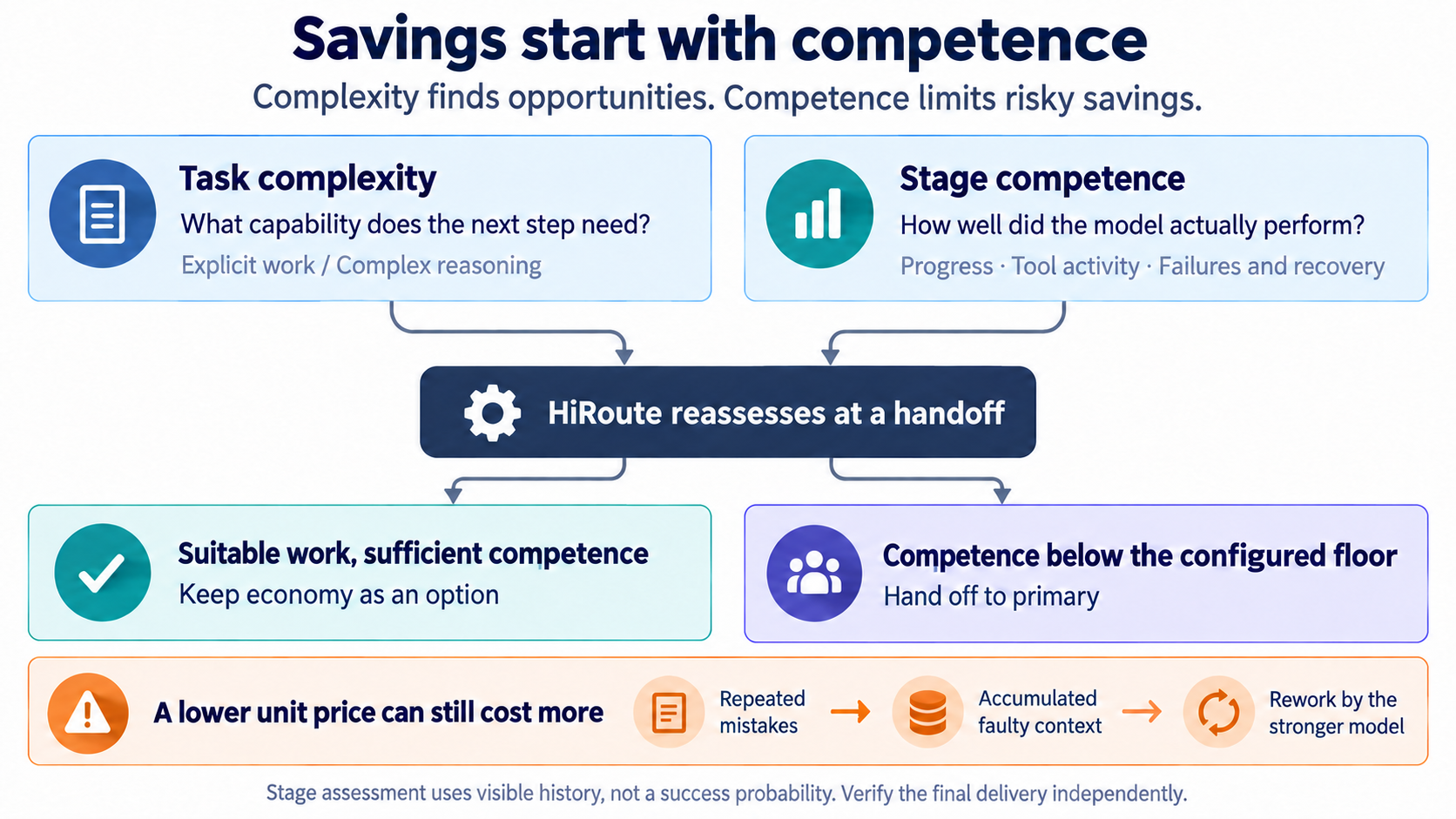
This matters especially in long tasks. As an agent accumulates context, it compresses history and continues from a summary. HiRoute detects continuity between requests and can reconsider the model at these context handoffs. Ordinary tool continuations retain the current route, keeping a stretch of execution stable.
“Let a stronger model take over” can then become part of the execution process, without waiting for a person to watch the conversation, spot a problem, and intervene.
Three handoffs, then 343 passing independent checks
HiRoute started with the economy model and used a stage-competence floor of 0.5. The actual sequence was Qwen → Astra → Qwen → Astra, with three automatic model changes. Nobody told the agent which model to use next.
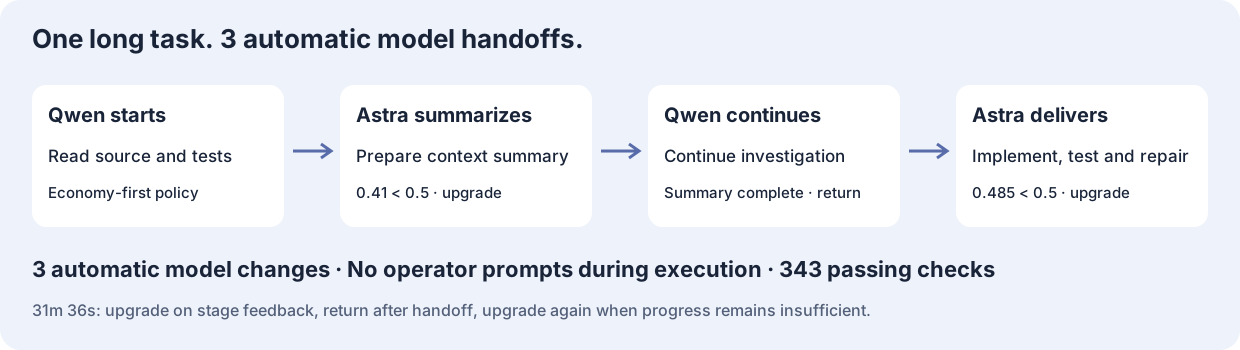
- First upgrade: prepare the context handoff. After Qwen read source and tests, the preceding stage scored 0.41, below the floor. HiRoute selected Astra to handle the pending context-summary request and prepare the handoff for continued execution.
- Return to Qwen: allocate work using stage feedback. The summary stage scored above the floor. Under the configured economy-first policy, Qwen got another opportunity to continue. A subsequent reassessment also retained Qwen.
- Upgrade again: turn investigation into implementation. Work still consisted of investigating source, tests and interfaces. At the second context handoff, the stage scored 0.485, again below the floor. HiRoute upgraded to Astra, which wrote the JSON streaming implementation, ran tests, and repaired asynchronous iterator closure, encoding and type-checking issues to complete the delivery.
| This long-running task | Result |
|---|---|
| Start to finish | 31 minutes 36 seconds |
| Automatic model changes | 3: two upgrades and one return to the economy model |
| Intermediate human prompts / human code patches | 0 / 0 |
| Astra tool calls after the key upgrade | 13 |
| Independent checks after execution | 108 feature + 229 regression + 6 incrementality checks, all passing |
This case shows execution feedback influencing model selection throughout the task: start economically, reassess at handoffs, upgrade when progress is insufficient, then let the stronger model continue implementation and validation. The user could focus on the deliverable. Explore the handoff and acceptance record.
Inspect each stage in HiRoute
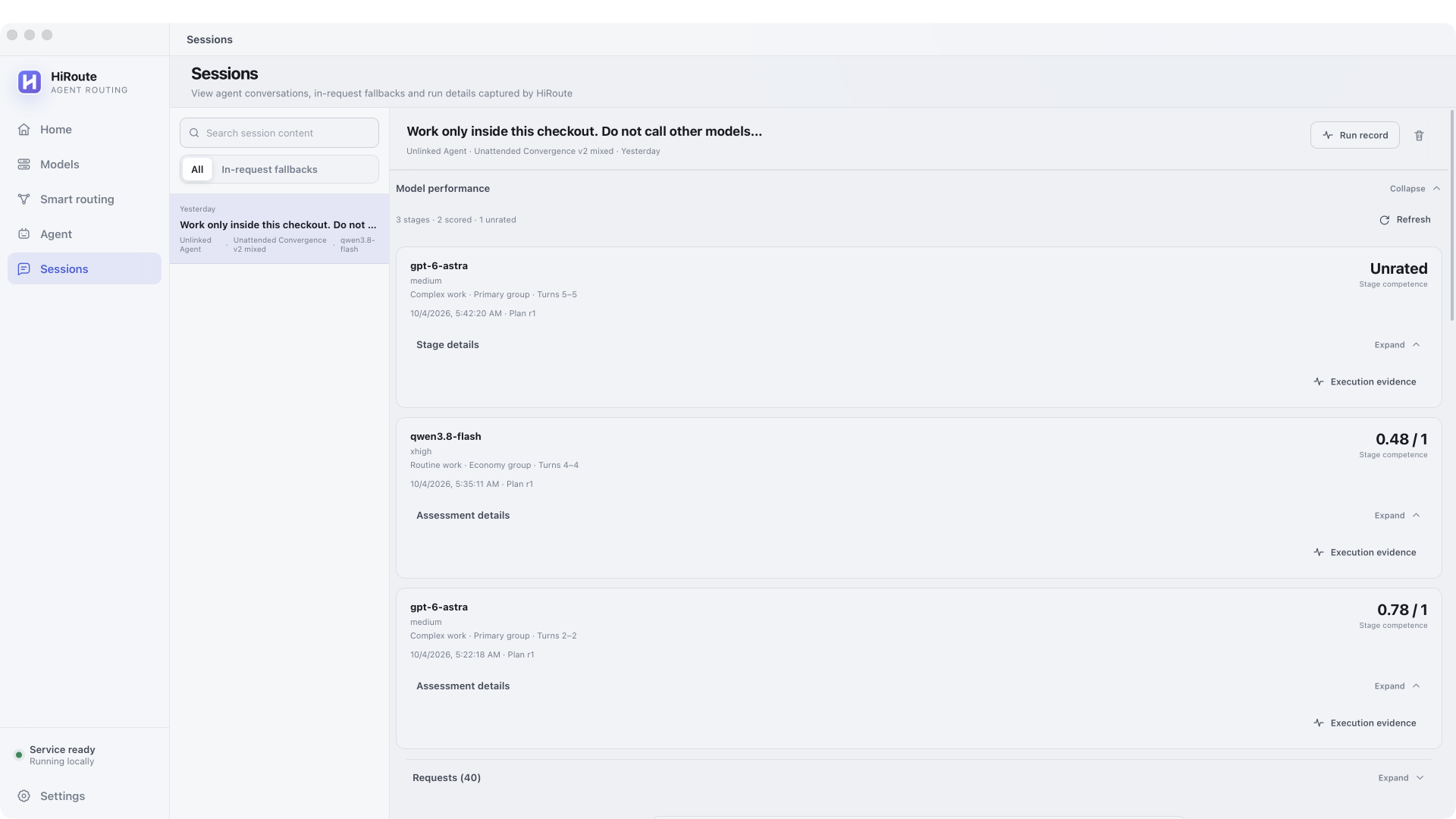
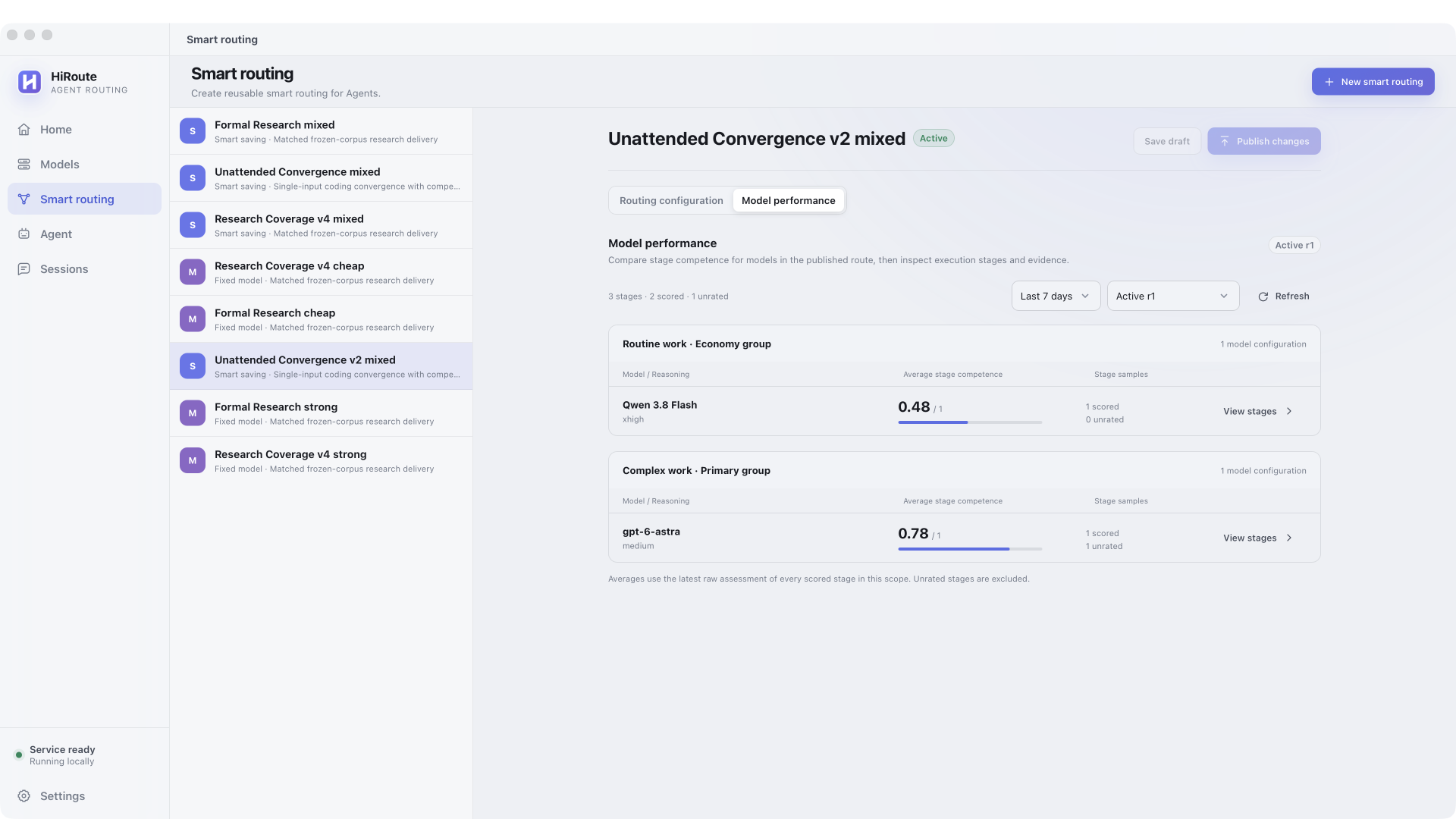
A session's Model performance view shows the actual model, reasoning setting, stage competence and execution turns. Open execution evidence to inspect the activity; expand assessment details to check coverage and open the assessment-trigger request. Stages that have not received a score remain visible too.
A routing plan's Model performance tab provides a broader perspective. Select a plan version and time range to inspect model configurations within each execution group, with average stage competence and counts of scored and unrated stages. A group can contain multiple models; different reasoning settings remain separate, and rows follow the plan's candidate order. Open a model's stages to inspect the underlying execution and assess which combination fits your tasks. Averages use the latest raw assessment of each scored stage in the scope; unrated stages are excluded.
Enterprise gateway experience, lightweight local execution
HiRoute brings the enterprise AI gateway capabilities and engineering experience developed through Higress AI Gateway to the developer's machine, with a lightweight local gateway core built in Rust. Desktop and CLI share the same local service for model connections, routing, failover and session observation.
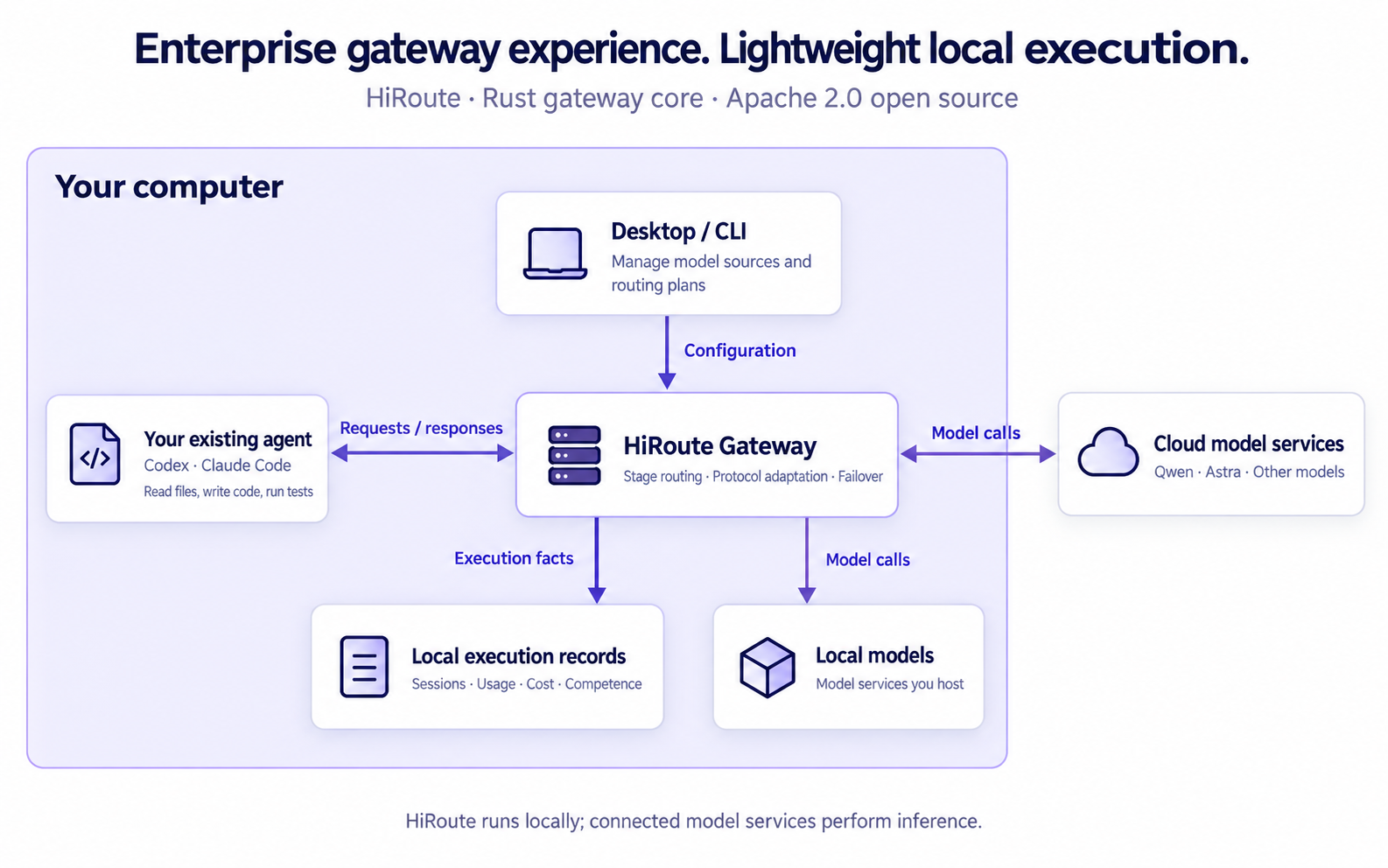
HiRoute's engine, configuration management and observation records run locally. Agent model requests enter the local Gateway, which routes them to the connected cloud or local model services; those services perform inference. Keep your existing agent without deploying an additional HiRoute cloud relay.
HiRoute's project code is fully open source under Apache 2.0, available to build, inspect and extend. The visual Desktop app and headless CLI use the same core, supporting both interactive use and automated workflows.
Start with your own agent
The tasks, evaluation results, and reproduction instructions for both cases are open source in the HiRoute repository.
Want to try it with your agent? Download HiRoute from the official website. The macOS installer is under 100 MB. Install it, connect your existing model services, choose a routing plan, and get back to work in the agent you already use.