

A DeepSeek-Style Super Agent with Hermes and HiRoute
On October 31 the DeepSeek Harness team published a long article, "Exploring Super-agent Design: Towards a More Autonomous Agent System", and open-sourced a research prototype, dsh-superagent-prototype. Its starting point resonated with me: one person can follow only three to five active Agent sessions at a time. As models get more capable, human attention becomes the bottleneck.
I use Hermes as my main Agent every day. It is an open-source personal agent framework that you can run from a chat app. Independent tasks I delegate through HiRoute to different execution Agents. Looking at DeepSeek's design, this combination already is a Super Agent: Hermes is the Router, and HiRoute's routing plans and execution Agents are the Workers. This article covers how it fits together, where it matches DeepSeek's prototype and where it differs, and the boundaries to know before you use it.
What DeepSeek proposed
The article describes a two-layer Router and Worker architecture:
- The Router is resident. It handles outside communication, overall coordination and dispatch, and need not execute tasks at all. In the public prototype the Router does not even get a Bash tool.
- Workers each focus on a single task in isolated context and return their results to the Router, which replies on their behalf.
With this split, the Router can always respond to new messages instead of getting stuck behind a long task, and each Worker sees only its own context, so tasks do not interfere with each other.
To be clear about what it is: dsh-superagent-prototype is a research prototype, not an official DeepSeek product. It works on one GitHub repository and can also listen to Feishu. When someone asks it for work, it opens a work item, runs it in its own session and directory, and answers in the original conversation, for example with a pull request. Later comments on the same work item go straight to the matching Worker through a subscription. The prototype's README also notes that some designs in the article are future directions that the prototype does not implement.
Three jobs for a Router
Putting this design into my own daily work, I find that a Router has at least three jobs:
- Stay unblocked. After dispatching a task, the Router must get straight back to the conversation, and when the task ends, someone has to bring the result back.
- Pick who does the work. Drafting, coding, correctness review and restructuring each suit a different execution Agent.
- Pick how expensive a model to use. Within one task, most steps are routine and only a few need a strong model.
DeepSeek's article focuses on the first job. The prototype creates a Worker for each new work item, and the model a Worker uses depends on the DeepSeek Harness profile you configure. The other two jobs are exactly what HiRoute does.
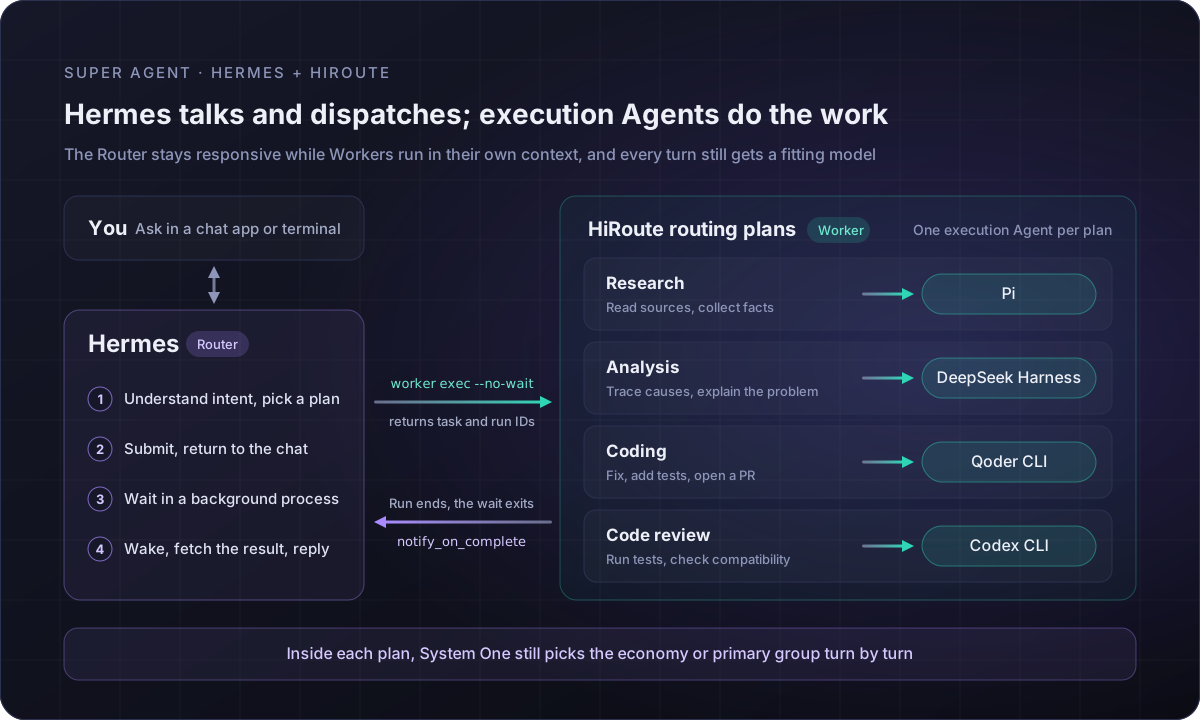
1. Stay unblocked: return on submit, wake on completion
Hermes hands off a task in two steps. The first is submitting it:
hiroute worker exec --plan <PLAN_ID> --cwd /work/hiroute --no-wait \
  -- "Read the error and logs in this issue, reproduce the problem, find the related code and write up an analysis"
With --no-wait, the command returns a task ID and a run ID as soon as the task is accepted, and Hermes goes straight back to the conversation. Several tasks can go out at once, each running in its own session.
The second step is waiting for the result, which relies on Hermes background processes and notify_on_complete. Hermes can run a command in the background, and with notify_on_complete turned on, Hermes wakes up and starts a new turn when that process exits. Note that the notification fires when the process exits, so it needs a command that keeps waiting until the task ends. If you turned on the notification for the --no-wait command above, it would exit right after submitting, and the notification would arrive while the task has only just started.
The wait uses hiroute worker wait, which keeps waiting until the task ends:
# Hermes runs this in a background process with notify_on_complete turned on
hiroute worker wait --run <RUN_ID>
When the task ends, the command exits, and Hermes wakes up, fetches the result with hiroute worker result --run <RUN_ID> and tells you in the conversation. The wait happens in the background, never occupies the conversation, and does not spend a model call every so often just to check the status.
Why not use Hermes's own subagents? Hermes's delegate_task can also run work in the background, but its documentation is explicit: top-level delegation is asynchronous yet still tied to the owning session and the Hermes process, so closing the session, /stop, /new or a process restart can cancel or strand work in progress. For work that must survive those boundaries, the documentation recommends scheduled jobs or a background process with notify_on_complete. HiRoute tasks run in HiRoute's background service, their results are stored, and you can look them up by run ID at any time.
2. Pick who does the work: one plan, one execution Agent
In HiRoute, each routing plan covers one kind of work and states three things: what the work is (its purpose); which execution Agent does it, one of Codex CLI, Claude Code, Qoder CLI, Pi, DeepSeek Harness or OpenCode; and how models are tiered into an economy group and a primary group.
Before delegating, Hermes runs hiroute worker plans, reads the published plans that allow delegation and picks one by the purpose each plan states. If none fits, it says so instead of forcing a choice. You can also name a plan directly: "Use HiRoute to delegate this task to [Research]."
Do not write a purpose as a vague word like "development" or "work". I spell out four things: what tasks it suits, what input and working directory it needs, what it delivers, and how it differs from neighboring plans. "Review a pull request and post comments back" and "Review a local diff and list the problems" should be two separate plans.
From my own use, the four execution Agents split the work roughly like this:
| Execution Agent | What I hand it |
|---|---|
| Pi | Research: reading issues and logs, searching code and docs, and turning the findings into a checklist; with a clear brief it runs fast |
| DeepSeek Harness | Research and analysis too, especially for problems whose causes take some untangling |
| Qoder CLI | Engineering: fixing bugs, adding tests and opening PRs |
| Codex CLI | Code review: running tests and checking edge cases and compatibility; slower and more expensive, so I save it for work where mistakes are costly |
This is my experience, not an evaluation result. Your tasks may call for a different split, and changing the execution Agent only means editing a plan, not touching Hermes.
3. Pick the model cost: another layer of routing inside each execution Agent
Choosing a plan only decides who does the work. The model behind each of that Agent's turns is decided by the plan's model routing. At the start of each turn, System One answers three questions: how did the last step go, how hard is this step, and will the last step's problem carry into this one. Simple-enough work goes to the economy group. When the last step fell short and the problem carries forward, the primary model takes over, and once the problem is resolved, work returns to the economy group. Tool calls within a turn never switch models, so the cache is not wasted.
For a delegated task, the first turn starts with the task itself; with no previous step, it is judged by difficulty alone. When Hermes adds a request to the same task with hiroute worker continue, that is a new turn, judged again with the previous turn's score.
So "who does the work" and "how expensive a model it uses" are two independent decisions: choosing Qoder CLI does not lock in a model tier. Over time, each plan's model performance report summarizes how well the economy group performs and, with enough evidence, suggests raising or lowering trust. A suggestion is only a suggestion, and nothing is published until you replay and confirm it.
A scenario: a morning of maintaining HiRoute
Take maintaining HiRoute, an open-source project. A typical morning goes like this.
A few new issues came in over the weekend: one says tool calls sometimes fail after connecting a certain model, one asks how to configure a proxy on a Linux server, and one suggests a new feature. I used to open each one, reproduce it and dig through the code, and the morning would be gone. Now I send Hermes one message in the chat app: "Look at the new issues from the weekend and find the cause of the ones you can reproduce. For confirmed bugs, fix them, open a PR and get it reviewed."
Hermes splits the work across plans:
- Research: Pi or DeepSeek Harness. One task per issue: read the error and logs, reproduce the problem, find the related code paths and check the provider's recent docs and changelogs. Routine ones go to Pi; ones whose causes take some untangling go to DeepSeek Harness.
- Coding: Qoder CLI. For a confirmed bug, Hermes hands the reproduction steps and the analysis to Qoder, which fixes it in its own working directory, adds tests and opens a PR. An issue that only needs clearer docs goes to Qoder as well.
- Review: Codex CLI. When the PR is up, Codex reviews it: it runs the tests, checks the fix against the reproduction steps and looks for compatibility breaks. Hermes sends Codex's findings back to Qoder's task with
hiroute worker continue, and Codex reviews again after the changes.
All of these tasks run in the background, and Hermes stays responsive. If I ask it something else meanwhile, it answers as usual, and whenever a task ends, it wakes up and sends me a summary. Inside each execution Agent, models switch step by step too: routine steps such as reading logs and running tests usually go to the economy group, while hard parts such as finding the root cause and designing a fix go to the primary model.
By the end of the morning, only two decisions are left for me: whether to build the new feature, and whether the fixed PR can be merged. That is the point of a Super Agent. The Router does not need to be good at everything, only to know what to hand to whom, and I no longer have to watch several Agent sessions at once.
How to set it up
The full steps are in smart task routing. Here are the three key ones:
- Create plans. Under Smart routing in HiRoute, create a plan for each kind of work, turn on Allow delegation to an execution agent, choose the execution Agent, write a clear purpose and publish. The execution Agent must pass its local dependency check before a task can start.
- Let Hermes delegate. On the Agent page, choose Hermes, open Task routing and choose when to delegate: only when you explicitly ask, or let the Agent decide by default. Save, then complete the task delegation skill check when prompted. You can also route Hermes's own model requests through HiRoute; the two settings are independent.
- Delegate from Hermes. Tell Hermes "Use HiRoute to delegate this task to [plan name]" or "Use HiRoute to delegate this task and choose a suitable route". Then add how to wait to Hermes's standing instructions: submit with
--no-wait; runhiroute worker wait --run <RUN_ID>in a background process withnotify_on_completeturned on; when woken, fetch the result withhiroute worker resultand reply.
Other personal agents such as OpenClaw can call the same hiroute worker commands directly, as long as they can run a local command line.
Boundaries to know first
This combination follows the same idea as DeepSeek's prototype but differs in a few ways:
- A non-executing Router is a convention, not isolation. DeepSeek's prototype simply gives the Router no Bash; Hermes keeps its own tools. If you let the Agent decide by default, it tends to delegate work that can run independently, but it does not lose the ability to execute. For hard isolation, restrict tools in Hermes's own configuration.
- Follow-ups go through the Router. In the prototype, later comments on a work item go straight to its Worker. Here, an execution Agent cannot ask you questions mid-task; Hermes sends any follow-up to the same task with
hiroute worker continue. - Completion notices follow the Hermes session. Notices reach only interactive sessions, such as chat apps, the terminal and the desktop app. If you start a new session with
/newbefore the task ends, that notice is dropped. The HiRoute task is unaffected, and you can fetch its result by run ID at any time. - Delegation is one level deep. An execution Agent cannot delegate further. Plan discovery, status checks, waiting and summaries all stay with Hermes.
- One plan binds one execution Agent. If a run fails, HiRoute does not switch to another kind of Agent.
- Execution permissions are not a sandbox. Execution Agents run with approve-all and can read and write files, run commands and access the network as far as their own capabilities allow. HiRoute provides no operating-system sandbox, so do not delegate work that must be strictly read-only. A working directory is not a lock either; if several tasks share one, keep them from overwriting each other.
- Cancelling stops only that run. Files already written and external actions already completed are not undone.
Closing thoughts
DeepSeek splits a Super Agent into a Router and Workers, and I agree with that direction. In daily work, though, you do not have to build one from scratch. A personal agent you already chat with, plus a layer of task routing, keeps the Router responsive and hands each task to a suitable execution Agent, while the model behind each of that Agent's turns is still chosen from evidence, one turn at a time.
HiRoute and Hermes are both open source. Give it a try, and tell us where it falls short.